Moving guide
Moving to Brooklyn: A Practical Guide
Brooklyn is the most populous of the five boroughs, and its neighborhoods share a borough and not much else. Most moving guides respond to that by ranking them, which is close to the least useful thing anyone can do with the information, because the ranking assumes it knows where you work. What follows is organized around the decisions instead, and around the specific pages you can check yourself rather than take on trust.
Decide the shape of the search
Three answers narrow the borough faster than any list, and they are worth settling before you open a listings site.
- Which subway line. Where you go most often decides this, and it removes most of Brooklyn immediately. A neighborhood that is wonderful and on the wrong line is the wrong neighborhood. Lines matter more than station counts: the R is a local that runs down Fourth Avenue and through Lower Manhattan, while the D and the N cross the Manhattan Bridge and run up Broadway and Sixth Avenue. Two trains at the same station can serve completely different halves of Manhattan.
- Which kind of building. Prewar walk-up or newer building with an elevator. This decides laundry, cooling, noise, moving day and whether shared amenities are in the rent or in your own budget. The comparison guide goes through it properly.
- How much density and noise. A commercial avenue, a quiet side street and a block beside an elevated expressway are three different lives at similar rents. This is the answer that changes most between a listing photo and a Tuesday evening on the sidewalk.
There is a fourth question that only applies to some people and matters enormously when it does: whether you need a station with an elevator. New York’s subway is old, and accessibility is uneven. The MTA publishes it station by station, and the State also publishes the same flags as open data. On the Fourth Avenue line, 59 St and Atlantic Av-Barclays Ctr are flagged accessible; 25 St, 36 St, 45 St and 53 St are not.
The neighborhoods, described
Descriptions rather than rankings, with the trade-off attached to each, because the trade-off is the part that gets left out. The subway column lists the lines that serve each area according to the State’s MTA Subway Stations dataset, which is the same source the maps are built from.
| Neighborhood | Subway | Known for | The trade-off |
|---|---|---|---|
| DUMBO and Brooklyn Heights | F at York St, A and C at High St, 2 and 3 at Clark St, R at Court St, 4 and 5 at Borough Hall | Waterfront and promenade, cobblestones, the shortest trip into Lower Manhattan. | The highest prices in the borough, and the least space per dollar. |
| Williamsburg | L at Bedford Av, J, M and Z at Marcy Av, G along the eastern edge | Nightlife, new towers, a waterfront that has been rebuilt twice. | Busy, expensive, and dependent on one subway line in much of it. |
| Park Slope | F and G at 7 Av, 2 and 3 at Grand Army Plaza, B and Q at 7 Av, R along Fourth Avenue | Brownstone blocks, Prospect Park, a long-settled main street. | Mostly prewar walk-ups, so laundry, elevators and cooling are usually your problem. |
| Prospect Heights | 2 and 3 at Eastern Pkwy-Brooklyn Museum, B and Q, C and the S shuttle at Franklin Av | The museum, the botanic garden, the library and the park all in one place. | Small, and priced accordingly. |
| Bedford-Stuyvesant | A and C along Fulton St, G at Bedford-Nostrand Avs, J and M at Marcy Av | Some of the borough’s finest brownstone architecture, and a lot of it. | Large, so the answer changes street by street more than the name suggests. |
| Bushwick | L at Morgan St and Jefferson St, M at Myrtle-Wyckoff Avs, J and Z along Broadway | Converted industrial buildings, murals, music, late nights. | Industrial edges, uneven housing stock, and a long trip to Midtown. |
| Greenwood Heights | R at 25 St, D, N and R at 36 St, F and G at Fort Hamilton Pkwy | The quieter strip between Park Slope and Sunset Park, next to Green-Wood Cemetery. | A name with no official boundary, so listings disagree about where it is. |
| Sunset Park | D, N and R at 36 St, R at 25 St, 45 St and 53 St | Three food corridors, the waterfront, the hilltop park, express trains on Fourth Avenue. | A working neighborhood with an industrial edge and an elevated expressway through it. |
| Bay Ridge | R at Bay Ridge Av, 77 St, 86 St and Bay Ridge-95 St | Wider streets, lower density, a long-established commercial avenue and the Narrows. | Further out, and mostly served by the R local. |
A pattern falls out of that table once you read the middle column first. North Brooklyn hangs off the L and the G. The brownstone belt is served by the F, the G, the 2 and the 3. The whole southwestern side of the borough runs on one spine, the Fourth Avenue line, where the D and the N run express through Sunset Park and the R makes every stop. If your office is in Lower Manhattan, the R corridor is worth more to you than any amenity. If it is in Midtown, the express trains are.
Two of these have guides of their own: Sunset Park and Greenwood Heights, and the Sunset Park and Park Slope comparison covers the border between them.
What it costs, and how to find the real number
Any rent figure published in an article is out of date and averaged across places that have nothing to do with each other. Four steps get you a number you can act on.
Get today’s number, not last year’s
Published median rents are stale by the time they are indexed and they average across neighborhoods that have nothing in common. Open two or three listing sites on the same afternoon, filter to one apartment size in two or three specific neighborhoods, and write down the ten cheapest and the ten most expensive results. The spread between them is what you are actually shopping in, and a single median hides all of it.
Add what the rent does not include
Electricity and gas, internet, renters insurance, laundry if it is not in the apartment, and a transit fare twice a day. The MTA publishes the current fare, which is $3 for most riders on the subway and on local, limited, rush and Select Bus Service buses, and $7.25 on express buses. Two trips a day, five days a week, is a line item worth writing down rather than waving at. In older buildings, add window air-conditioners and the summer electricity that runs them.
Price the move itself
Movers price stairs, so a fourth-floor walk-up costs more to move into than an elevator building. Get quotes for the actual floor rather than the building, and ask whether the quote includes a certificate of insurance for the receiving building, because most elevator buildings will not let a crew through the door without one. Remember that you may be paying rent in two places for part of a month.
Work out the cash needed at signing
First month, a security deposit where one applies, and any charge that survives the FARE Act. The City’s Tenant Bill of Rights states the two caps plainly: a security deposit “that does not exceed one month’s rent”, and “Landlords are not allowed to charge you more than $20 for an apartment application.” The table below turns that into an arithmetic you can run before you walk into a signing.
The cash you need on signing day
Six lines, two of which the City caps by law. Fill in your own rent and you have the total before anyone asks you for a certified check.
| Line item | Rule of thumb | What to check |
|---|---|---|
| First month’s rent | Always due | The rent on the lease. If the lease starts mid-month, ask whether the first payment is prorated. |
| Security deposit | Capped at one month | The Tenant Bill of Rights caps it at one month’s rent. HPD also states you are entitled to get it back with interest at the end of the tenancy. |
| Application and screening | Capped at $20 | Covers the background and credit check. A larger "application fee" is not something you have to accept quietly. |
| Broker fee | Depends who hired the broker | A broker the landlord hired may not bill you. A broker you hired to search for you may. |
| Movers and the COI | Varies | Quote the actual floor and the actual stairs. Ask for the certificate of insurance in writing before the day. |
| Overlapping rent | Often overlooked | Most people pay two rents for part of one month. Budget it rather than discovering it. |
Worked example, with a round number chosen for the arithmetic rather than because it is anyone’s rent. On a $3,000 apartment with a deposit, you are looking at $3,000 for the first month, up to $3,000 for the deposit and up to $20 for the application, which is $6,020 before movers. Add the mover quote and any overlapping rent, and that is the number to have ready. If a landlord asks for first, last and a deposit, that is a question rather than a bill: the Rent Guidelines Board’s security deposit guidance states that a security deposit can be no more than one month’s rent, that a landlord may not charge more than one month’s rent for a security deposit or advance fee, and that the deposit must be held in an interest bearing account at a New York State bank.
The search and the application
Timing
New York listings appear late, often a few weeks to about a month before the available date, and they move quickly. Six months out there is nothing to see. Six to eight weeks out, with your documents already in one folder, is the window where preparation actually pays.
Broker fees
Since the FARE Act took effect on June 11, 2025, the party who hires the broker pays the broker. A broker the landlord hired to fill the apartment may not charge you its fee. A broker you hire to search on your behalf is yours to pay. DCWP’s FARE Act guidance goes further than the fee itself: every fee a prospective tenant must pay has to be disclosed “in a clear and conspicuous manner” in the listing, and you are entitled to an itemized written disclosure of all fees before you sign. If a charge appears at the signing table that was in neither place, that is the moment to ask about it. Complaints go to DCWP or through 311.
Documents
Government ID, recent pay stubs, an employment letter, tax returns, bank statements and a landlord reference. Have them in one folder you can send in one message, because the difference between applying the same day and applying three days later is usually the apartment. Pull your own credit report first at annualcreditreport.com so that nothing in it is a surprise to you before it is a surprise to a landlord. The application guide covers income review, credit, guarantors and what the law caps.
Getting around
The subway is the whole system, and which line you are on matters more than how many stations are nearby. Fares and transfers work the same everywhere, so the real variables are your line, your transfer and the hour you travel. The MTA lists the fare at $3 for most riders on subways and local buses, with reduced fares for seniors and riders with qualifying disabilities set at half the regular fare.
Buses fill the crosstown gaps the subway leaves, which in Brooklyn is most east-to-west travel. Citi Bike covers the network and describes itself as the country’s largest bikeshare, with more than 35,000 bikes and over 2,300 stations across four boroughs plus Jersey City and Hoboken. If you ride your own bike, NYC DOT publishes a cycling map every spring showing protected lanes, conventional lanes, shared lanes and greenways, and you can order printed copies through 311.
NYC Ferry runs along the waterfront. The South Brooklyn route stops at East 34th Street, Corlears Hook, Wall Street/Pier 11, Atlantic Avenue/Brooklyn Bridge Park Pier 6, Red Hook, Sunset Park/Brooklyn Army Terminal, Bay Ridge and Governors Island, and the operator lists the adult one-way fare at $4.00 with free transfers within the system for 120 minutes. Check the published schedule before you plan a commute around it, because the ferry runs to a timetable rather than a frequency.
On cars: most people here do not keep one, and parking is genuinely difficult in most of the borough. If you are bringing one, look for a building with a garage and read the parking guide first, because a listed garage and an available space are two different things.
Moving day, the part nobody plans
The apartment search gets months of attention and the move itself gets a weekend. Four things, done early, remove most of what goes wrong.
Ask for the building’s move-in rules in writing
Permitted days and hours, whether a freight elevator has to be reserved, what the certificate of insurance has to say and who it has to name. Ask at the lease signing, not the week before the truck. Buildings that require a COI will turn a crew away without one.
Solve the truck parking before the truck arrives
Read the signs on the block you are moving into, on both sides. Alternate side parking rules apply for the entire time posted on the sign even if the sweeper has already been through, and NYC311 notes a five-minute grace period and nothing more. Double parking a passenger vehicle is illegal at all times, including during street cleaning.
Check whether the rules are suspended that day
NYC DOT publishes an alternate side parking suspension calendar for the year, downloadable and importable into a calendar app. Suspensions also happen for weather and emergencies, which DOT says to check through NYC311 or Notify NYC.
Set up the address changes in one sitting
Mail forwarding, bank, employer, voter registration, any prescription that gets delivered. Do it in one sitting the week before rather than in twelve interruptions over two months.
Checking a neighborhood yourself
Five things, none of which can be outsourced to an article, including this one.
Walk the actual block, twice
Once on a weekday morning and once after dark. Blocks change more between hours than neighborhoods change between names. Look at what is open at 9pm, how the street lights sit, whether the sidewalk is busy or empty, and what the building across the road is used for.
Ride the commute you will really make
Your destination, your hour, your transfer. Plan it on the MTA subway map, check the service alerts for planned weekend work on that line, then do the trip once for real. If stairs matter to you, check the station on MTA accessibility first. Most of the older Brooklyn stations have no elevator.
Read the public safety data yourself
No article should hand you a ranking. The guide to checking NYPD sources explains which source answers which question and what each one leaves out. Every address in the city sits inside a numbered precinct, and each precinct publishes its own figures.
Do a real grocery run
Shop where you would shop and carry it back the way you would carry it, up the stairs included. Half an hour of that tells you more than a week of reading, because it is the thing you will do fifty times a year. Do the same for a pharmacy, and for a laundromat if the building has none.
Go to a community meeting
Precinct community councils meet monthly and are open to anyone. The 72nd Precinct, which covers Sunset Park and Windsor Terrace, lists its council meeting as the second Tuesday of each month at 7:30 PM. An hour in that room tells you what people who already live there are actually worried about.
If schools, parks or city services matter to your household, go to the source rather than a roundup. New York City Public Schools and the City’s MySchools directory let you look up a specific address, and NYC Parks publishes hours and facilities park by park. All three stay current in a way published articles do not.
Where 875 Fourth Avenue fits
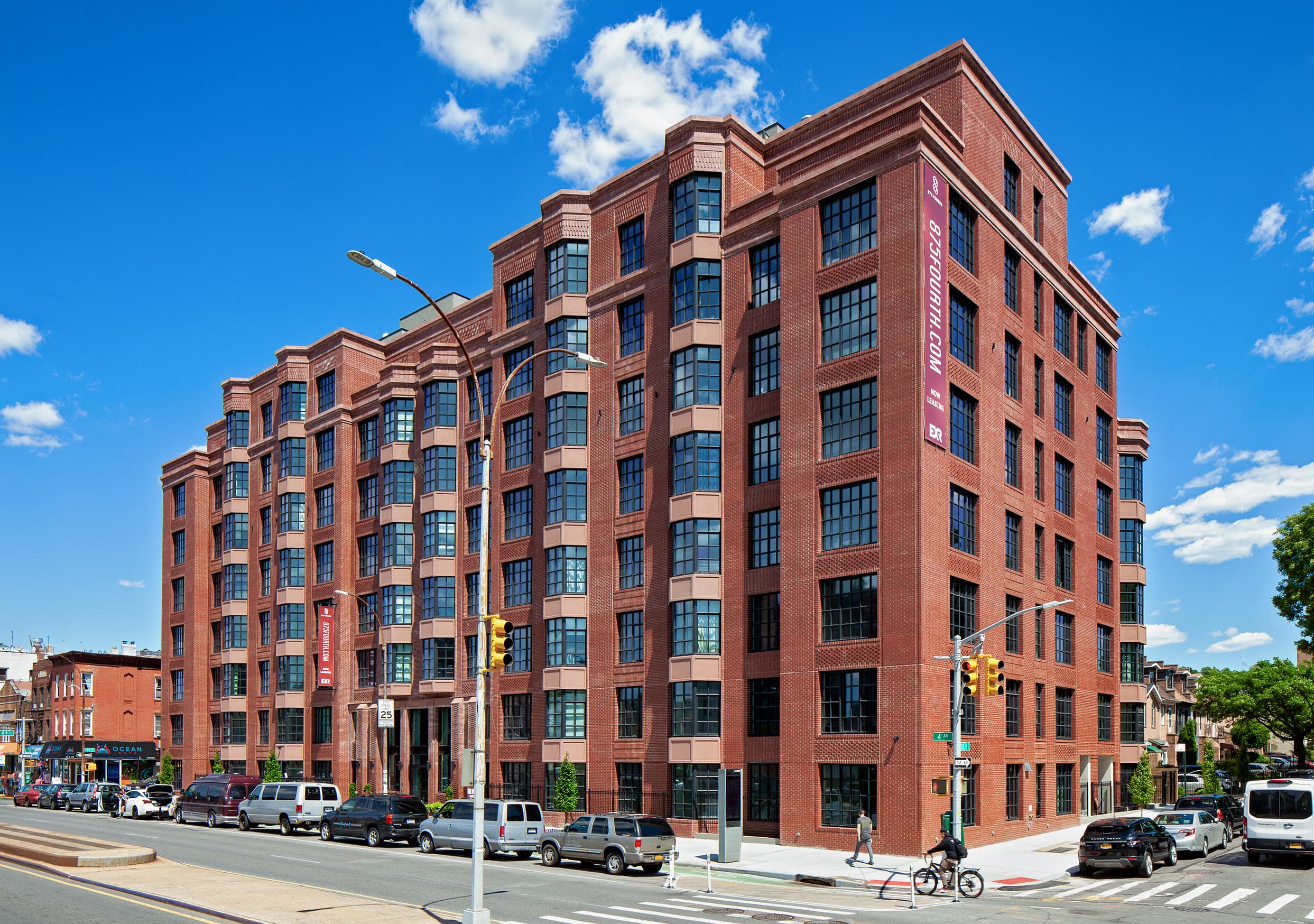
875 Fourth Avenue sits on Fourth Avenue near the 36 Street D, N and R station, in the stretch where Sunset Park, Greenwood Heights and Park Slope meet. It is a newer building, which puts it on the elevator-and-amenities side of the decision above.
- 150 residences, with stainless steel appliances and quartz countertops. Every residence includes a dishwasher.
- Apartments use split-system A/C units. Confirm controls and the heating setup for the specific residence with EXR leasing.
- Ask EXR leasing to confirm the laundry equipment and setup in the specific residence you are considering.
- A furnished rooftop terrace with Manhattan skyline views; The building's grills are on the rooftop terrace only.
- The building has a resident fitness center. The fitness center is open daily from 6:00 AM through 11:59 PM. The building has a resident co-working lounge.
- An on-site garage with 21 parking spaces. Current availability, pricing, eligibility, and assignment terms must be confirmed with EXR leasing.
- Doorman service is provided from 9:00 AM to 5:00 PM, seven days a week.
Ceiling height, windows, closets, outdoor space, and the view vary by residence; ask EXR leasing to confirm them for the specific home you are considering. Current homes, asking rents and any listed concession are on the availability page.
Questions people ask
When should I start looking for a Brooklyn apartment?
Most New York listings appear a few weeks to about a month before the available date, so a search that starts six months out finds very little. Start roughly six to eight weeks before you need to move, with your documents already assembled.
Do I have to pay a broker fee in Brooklyn?
Not to a broker the landlord hired. The FARE Act, in effect since June 11, 2025, means the party who hires the broker pays the broker. DCWP also requires that all fees a prospective tenant must pay be disclosed clearly in the listing, and itemized in writing before you sign. If you hire your own broker to search for you, you pay that one.
How much cash do I need at lease signing?
Usually the first month plus a security deposit where one applies. The NYC Tenant Bill of Rights caps that deposit at one month of rent and caps an apartment application charge at $20. Ask for an itemized list of every charge before you agree to anything, which the FARE Act requires anyway.
Do I need a car in Brooklyn?
Most people do not, and parking is genuinely difficult in most of the borough. If you keep one, look for a building with a garage and read the parking guide before you assume street parking will work. A street cleaning ticket in New York City is $65 plus a $15 state surcharge.
Which Brooklyn neighborhood should I choose?
Decide the shape of the search first: which subway line serves your destination, whether you need an elevator or laundry, and how much noise and density you want. Those three answers narrow the borough faster than any neighborhood ranking.
Are Brooklyn subway stations accessible?
Many are not. The MTA publishes station-by-station accessibility, and the City and State open data both carry the same flags. On the Fourth Avenue line, for example, 36 St, 25 St and 45 St have no elevator, while 59 St and Atlantic Av-Barclays Ctr do. Check your own station before you sign.
Start with one visit
Send a tour request with your preferred timing, then walk the blocks around it and ride the train once. Everything in this guide is preparation for that afternoon.