Neighborhoods
Eight Brooklyn Neighborhoods, Compared for Renters
Every Brooklyn neighborhood guide arrives as a ranked list, which is a strange way to answer a question that depends entirely on where you work, what you can spend and what you can live next to. This one compares eight areas on the things that actually differ between them, and leaves the weighting to you.
How to use this
Three dimensions separate Brooklyn neighborhoods more than anything else: which subway lines serve them, what the housing stock is, and what the street is like. Everything else, including price, moves too fast to publish and follows from those three anyway.
There is a fourth dimension worth settling early if it applies to you, which is whether your station has an elevator. The subway is old and accessibility is uneven. Of the stations named in this guide, the State’s open data flags Atlantic Av-Barclays Ctr, Jay St-MetroTech, Borough Hall, DeKalb Av, Bedford Av, Metropolitan Av, 7 Av on the F and G, Marcy Av and Myrtle-Wyckoff Avs as accessible, and flags Grand Army Plaza, 15 St-Prospect Park, Carroll St, Bergen St, Clark St, York St, 25 St and 36 St as not.
What the lines actually serve
The subway column below is only useful if you know what each letter does once it leaves Brooklyn. This table lists the Manhattan stops on each line, taken from the State’s MTA Subway Stations dataset. Read the row for the line that reaches your office, then read the neighborhood table.
| Line | Manhattan corridor | The stops that matter |
|---|---|---|
| R | Lower Manhattan and the Broadway local | City Hall, Cortlandt St, Rector St and Whitehall St, then up through Union Square, Herald Square and Times Square to 57 St and Lexington Av/59 St. |
| D and N | Midtown, by two different routes | The D crosses the Manhattan Bridge for Sixth Avenue: Broadway-Lafayette St, W 4 St, Herald Square, Bryant Park, Rockefeller Center and Columbus Circle. The N runs Broadway to Canal St, Union Square, Herald Square, Times Square and 59 St. |
| F and G | Sixth Avenue, and nothing at all | The F runs up Sixth Avenue through W 4 St, Herald Square, Bryant Park, Rockefeller Center and Lexington Av/53 St. The G has no Manhattan stops whatsoever, which surprises people every year. |
| L | The 14th Street crosstown | Five Manhattan stops, all on 14th Street: 1 Av, 3 Av, Union Square, 6 Av and 8 Av. Excellent if you work there, a transfer if you do not. |
| A and C | The Eighth Avenue spine | Fulton St, Chambers St, Canal St, W 4 St and up the West Side. The A runs express and skips most of the C stops. |
| 2, 3, 4 and 5 | The East Side and the Financial District | The 4 and 5 run Grand Central, Union Square, Brooklyn Bridge-City Hall, Fulton St, Wall St and Bowling Green. The 2 and 3 run the West Side through Chambers St, Park Place, Fulton St and Wall St. |
| B and Q | Sixth Avenue and Second Avenue | The B runs Sixth Avenue with the D. The Q runs Broadway then swings east to Lexington Av/63 St and up Second Avenue to 72 St, 86 St and 96 St. |
| J, M and Z | The Lower East Side and downtown | The J and Z stop at Delancey St-Essex St, Canal St, Chambers St, Fulton St and Broad St. The M leaves them at Essex Street and runs up Sixth Avenue instead. |
Two things fall out of that table. The first is that a station with four lines is not automatically better than a station with one, because what counts is whether one of them reaches you without a transfer. The second is the G, which is a genuinely useful north-south Brooklyn line and reaches no part of Manhattan at all. Plan any G commute as a transfer from the start. Confirm the trip you will make on the subway map and check service alerts for planned work on that line, which tends to land on weekends.
The eight, side by side
Housing stock is the column people skim and then regret skimming. It decides whether a gym, an elevator, a package room and in-unit laundry are even on the table in that part of Brooklyn, and no amount of searching produces a building type the neighborhood does not have.
| Neighborhood | Subway | Housing stock | What the street is like |
|---|---|---|---|
| Williamsburg | L, plus the G and the J, M and Z at the south end | New towers on the waterfront, older stock inland | Nightlife, restaurants, the shortest hop into the East Village |
| Bushwick | L, J, M and Z | Converted industrial buildings and older low-rise | Studios, music, murals, late nights, industrial edges |
| DUMBO | F, A and C nearby | Converted warehouses and newer towers | The waterfront, the bridges, the shortest trip to Lower Manhattan |
| Brooklyn Heights | 2, 3, 4, 5, R, A and C | Historic district, largely prewar | The promenade, quiet streets, the densest transit in the borough |
| Park Slope | F, G, R, and the 2 and 3 at Grand Army Plaza | Mostly prewar brownstones and walk-ups | Prospect Park, a settled main street, few elevators |
| Crown Heights | 2, 3, 4, 5, A, C and S | Prewar apartment buildings and brownstones | The museum and botanic garden, Franklin Avenue, more space per dollar |
| Bedford-Stuyvesant | A, C, G, J, M and Z | Brownstones, in quantity | Architecture, quiet blocks, a neighborhood large enough to vary street by street |
| Sunset Park and Greenwood Heights | D, N and R, with express service at 36 Street | A real mix of prewar and recent construction | Three food corridors, the waterfront, Green-Wood, buildings with elevators |
North Brooklyn
Williamsburg
The waterfront towers and the inland blocks are almost two different neighborhoods at the same address. Density of restaurants and bars is the draw, the L is the spine, and much of it depends on that one line more than people notice until it is disrupted.
Practical test before you commit: stand at Bedford Av and work out your route to work without the L. If the answer is a bus to the G and then a transfer, you have learned what a weekend of track work will cost you. The blocks closest to the waterfront have most of the newer buildings with elevators; walk ten minutes inland and the stock turns over to older low-rise.
Bushwick
Converted industrial buildings, studio space, music and murals, at the cost of a longer trip to Midtown and housing stock that varies enormously from block to block. Go and look at the specific building; the neighborhood average means very little here.
The J, M and Z are the part of Bushwick transit that gets ignored. The M runs up Sixth Avenue through Midtown, which is a very different commute from the L, and the J and Z run straight into the Financial District. If your office is downtown rather than in Midtown, the eastern side of Bushwick is worth more to you than the L blocks everyone photographs.
DUMBO
Warehouses, bridges and the shortest trip into Lower Manhattan, with the highest prices in the borough and the least space per dollar. Spectacular, and priced like it.
Worth knowing before you fall for it: York St on the F is not flagged accessible, the cobblestones are genuinely hard on a suitcase or a stroller, and the area is small enough that one building coming online moves what is available. Brooklyn Bridge Park sits along the waterfront and does a lot of the work that a private amenity does elsewhere.
The brownstone belt
Brooklyn Heights
The promenade, a historic district, and the densest transit in Brooklyn. It is quiet. It is also long settled and mostly prewar, so every prewar question about laundry, elevators and cooling applies here too. Borough Hall and Jay St-MetroTech are both flagged accessible; Clark St, where the 2 and 3 stop, is not. If that matters to you, check your own station on MTA accessibility before you shortlist the block.
Park Slope
Prospect Park, a settled main street and a great many walk-ups. Transit is genuinely good, with the F and G alongside the R and the 2 and 3 at Grand Army Plaza. The comparison with Sunset Park covers what the premium buys and what it does not.
The three Park Slope stations sit on three different systems, which is the real argument for the neighborhood. 7 Av on the F and G is flagged accessible, Grand Army Plaza on the 2 and 3 is not, and the R runs beneath Fourth Avenue at the western edge. The practical consequence is that the same neighborhood name covers a ten minute difference in commute depending on which end of the slope you land on, so price the specific blocks rather than the name.
Crown Heights
The Brooklyn Museum, the botanic garden and the eastern side of Prospect Park, with prewar apartment buildings that tend to offer more room than equivalent money buys further west. Transit is the strong suit: the 2, 3, 4 and 5 all run through it on Eastern Parkway, the A and C sit to the north, and the Franklin Avenue shuttle connects the two. Eastern Pkwy-Brooklyn Museum and Franklin Av are both flagged accessible.
Bedford-Stuyvesant
Some of the finest brownstone architecture in the city, over a large enough area that the name tells you less than the cross street does. Well served by trains, and genuinely variable block to block.
Three separate systems cross it: the A and C along Fulton Street, the G at Bedford-Nostrand Avs, and the J and M at Marcy Av and Flushing Av. Which one you live near changes the commute completely, and a listing that says “Bed-Stuy” is describing an area big enough to contain all three. Look up the actual nearest station before you compare two listings on price.
South and west
Sunset Park and Greenwood Heights
The Fourth Avenue corridor is the part of this list where recent construction and older stock actually sit side by side, which means elevators, shared amenities and garages are available in a way they are not in the brownstone neighborhoods. The D, N and R run beneath it, and 36 Street is an express stop.
That express stop is the thing to understand about this corridor. The D and the N serve Midtown by two different routes while the R makes every stop down to Lower Manhattan, so one station covers both halves of Manhattan without a transfer. The trade-off is that neither 36 St nor 25 St is flagged accessible, and the nearest accessible stations on the line are 59 St to the south and Atlantic Av-Barclays Ctr to the north.
Above ground it is three food corridors, the Industry City waterfront, Green-Wood Cemetery at the northern edge and a hilltop park with harbor views. The park the neighborhood is named for is listed in the City’s Parks Properties dataset at 24.5 acres, running from 41st Street to 44th Street between Fifth and Seventh Avenues. Green-Wood’s own hours page puts one of its four gates on Fourth Avenue at 35th Street, open 8am to 4pm daily. It is also a working neighborhood with an industrial western edge and an elevated expressway running through it, which is worth standing on a sidewalk to judge. The Sunset Park guide and the Greenwood Heights guide both go into it properly.
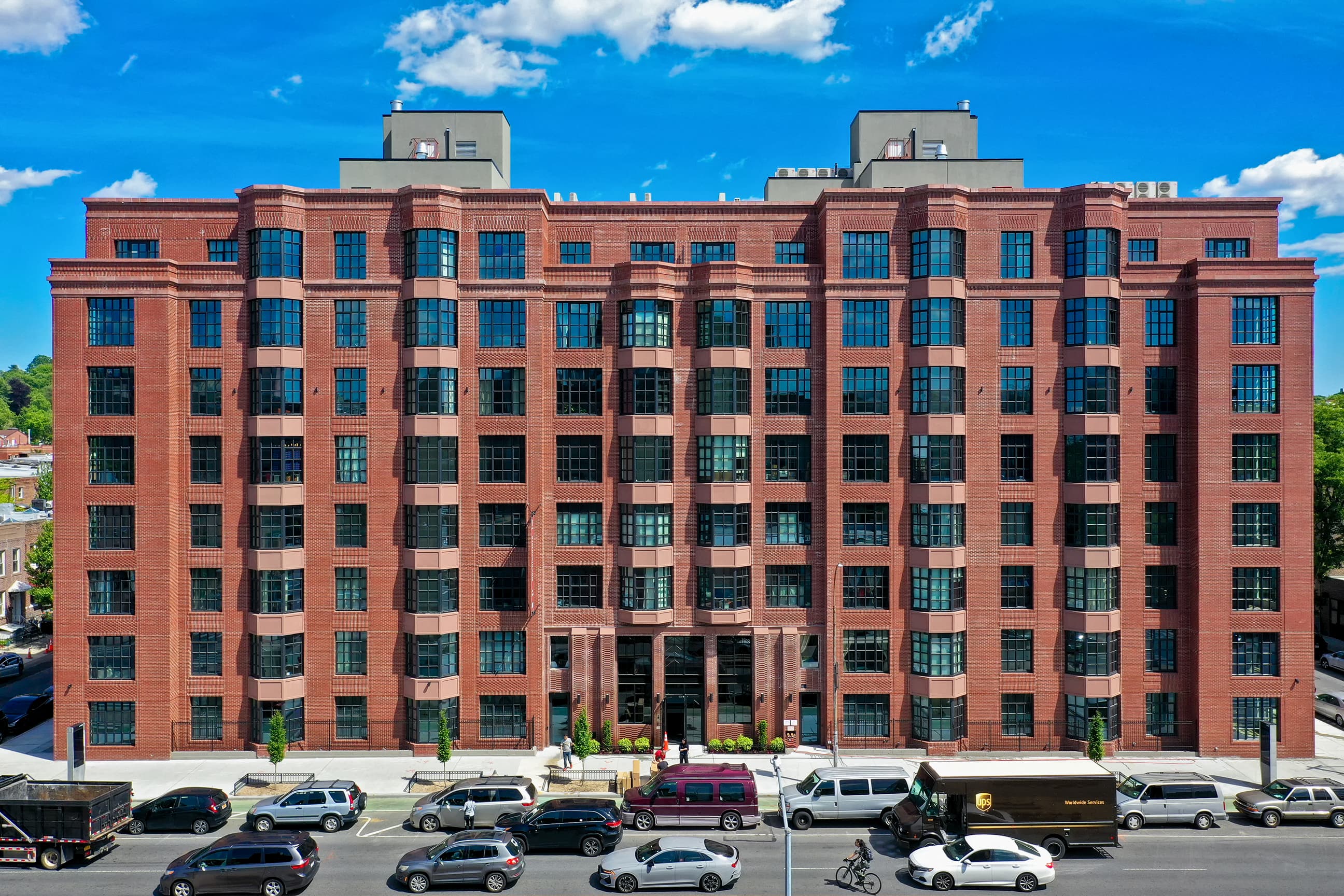
875 Fourth Avenue is on this corridor. It holds 150 residences. Every residence includes a dishwasher. Apartments use split-system A/C units. There is a furnished rooftop terrace with Manhattan skyline views, The building's grills are on the rooftop terrace only. The building has a resident fitness center. The building has a resident co-working lounge. An on-site garage holds 21 parking spaces. Current availability, pricing, eligibility, and assignment terms must be confirmed with EXR leasing. Ceiling height, windows, closets, outdoor space, and the view vary by residence; ask EXR leasing to confirm them for the specific home you are considering. Current homes and asking rents are on the availability page.
What to check on a viewing
Once the list is down to two neighborhoods you will be standing in apartments, and a viewing is fifteen minutes in which it is very easy to look at the wrong things. These five questions will tell you whether you are in a good apartment or just a well photographed one.
Ask what the laundry situation actually is
In the apartment, in the building, or down the street. No other amenity shapes a week this much, and listings are vague about it on purpose. Ask where the machines are, how many there are and what they cost.
Find out how the apartment is heated and cooled
Radiators with no thermostat behave very differently from a system you control. Ask who controls the heat, what the cooling is, and whether window units are permitted if there is no built-in system. Then ask what a January and an August bill look like.
Open a window and listen
For a full minute, at the hour you would be home. An avenue, a side street and a block beside an elevated road sound completely different, and no photograph carries it.
Check the phone signal in the back room
Thick masonry and below-grade rooms swallow signal. Thirty seconds of walking around with your own phone answers a question you will otherwise live with.
Ask what the building does about packages
A doorman with set hours, a package room, a lobby shelf or nothing at all. Ask what happens to a delivery that arrives while you are at work, and what the building does about mail when you travel.
Narrowing it to two
Five steps, in this order. Done properly it takes an afternoon and saves you a year of living somewhere that does not fit.
Start from the subway line
Put your most frequent destination into the MTA subway map and see which lines actually serve it. That usually removes half this table before you have thought about anything else.
Decide the building type
Prewar walk-up or newer building with an elevator. It decides laundry, cooling, noise and whether a gym and a roof are in your rent or in your budget. The comparison guide goes through the trade-offs.
Price two neighborhoods on the same day
One apartment size, live listings, two neighborhoods, same afternoon. Write down the ten cheapest and the ten most expensive results in each, then compare the spreads instead of the middles. It takes twenty minutes and no published average comes close.
Ride both commutes, at your hour
Not the estimate, the trip. Leave at the time you would leave, take the transfer you would take, and note what the platform is like when you get there. Two neighborhoods that look equivalent on a map routinely differ by fifteen minutes in practice.
Walk both, at your hours
A weekday morning and an evening. Everything above is preparation for this, and this is what actually decides it. Buy something, sit somewhere, and pay attention to how long it takes to do an ordinary errand.
One thing to carry into all five: no published number about a neighborhood is as useful as the same search run twice. Save the two searches, run them again a week later, and watch what moved. Listings that vanish in three days and listings that sit for a month tell you more about a market than any average does.
Questions people ask
Which Brooklyn neighborhood has the best transit?
Brooklyn Heights has the densest concentration of lines, with the 2, 3, 4, 5, R, A and C within a short walk. What matters more than the count is whether one of those lines goes where you go.
Where in Brooklyn can I find a building with an elevator and a gym?
Mostly where recent construction happened: the Williamsburg and DUMBO waterfronts, and the Fourth Avenue corridor through Greenwood Heights and Sunset Park. The brownstone neighborhoods have very little of it.
Which Brooklyn neighborhood is cheapest?
That changes constantly and depends on apartment size and building type, so no published figure is worth acting on. Compare live listings for the same size in two or three specific neighborhoods on the same day.
Why does this guide not rank the neighborhoods?
Because a ranking has to assume a set of priorities, and they would not be yours. Comparing them on subway lines, housing stock and trade-offs lets you apply your own weighting, which is the part a published ranking quietly takes away from you.
Does the G train go to Manhattan?
No. The State open data for MTA subway stations lists no Manhattan stop on the G at all. It is a useful north-south line within Brooklyn and Queens, and any commute into Manhattan on it starts with a transfer, most often to the L, the F or the A and C.
Which Brooklyn subway stations have elevators?
Fewer than people expect, and the pattern is not geographic. On the Fourth Avenue line, 59 St and Atlantic Av-Barclays Ctr are flagged accessible while 25 St, 36 St, 45 St and 53 St are not. In Park Slope, 7 Av on the F and G is flagged accessible and Grand Army Plaza is not. Check your own station on the MTA accessibility pages before you shortlist a block.
What should I ask at an apartment viewing?
Where the laundry is and what it costs, who controls the heat and what the cooling is, what a summer and a winter bill look like, what happens to a package that arrives while you are at work, and what the street sounds like with the window open at the hour you would be home.
Put one of them on the list
Send a tour request with your preferred timing and walk the Fourth Avenue corridor while you are here. Comparing two neighborhoods on foot beats comparing eight of them on a page.